> ## Documentation Index
> Fetch the complete documentation index at: https://docs.valuez.ai/llms.txt
> Use this file to discover all available pages before exploring further.
# Call Logs
> Review every conversation your AI agents have handled - transcripts, latency, credits, and more.
Call Logs is your complete record of every conversation handled by your AI agents. Every test call, live call, and API interaction is logged here automatically - with full transcripts, timing data, credit usage, and caller information.
Click **Call Logs** in the left sidebar to open the logs screen.
***
## The Call Logs List
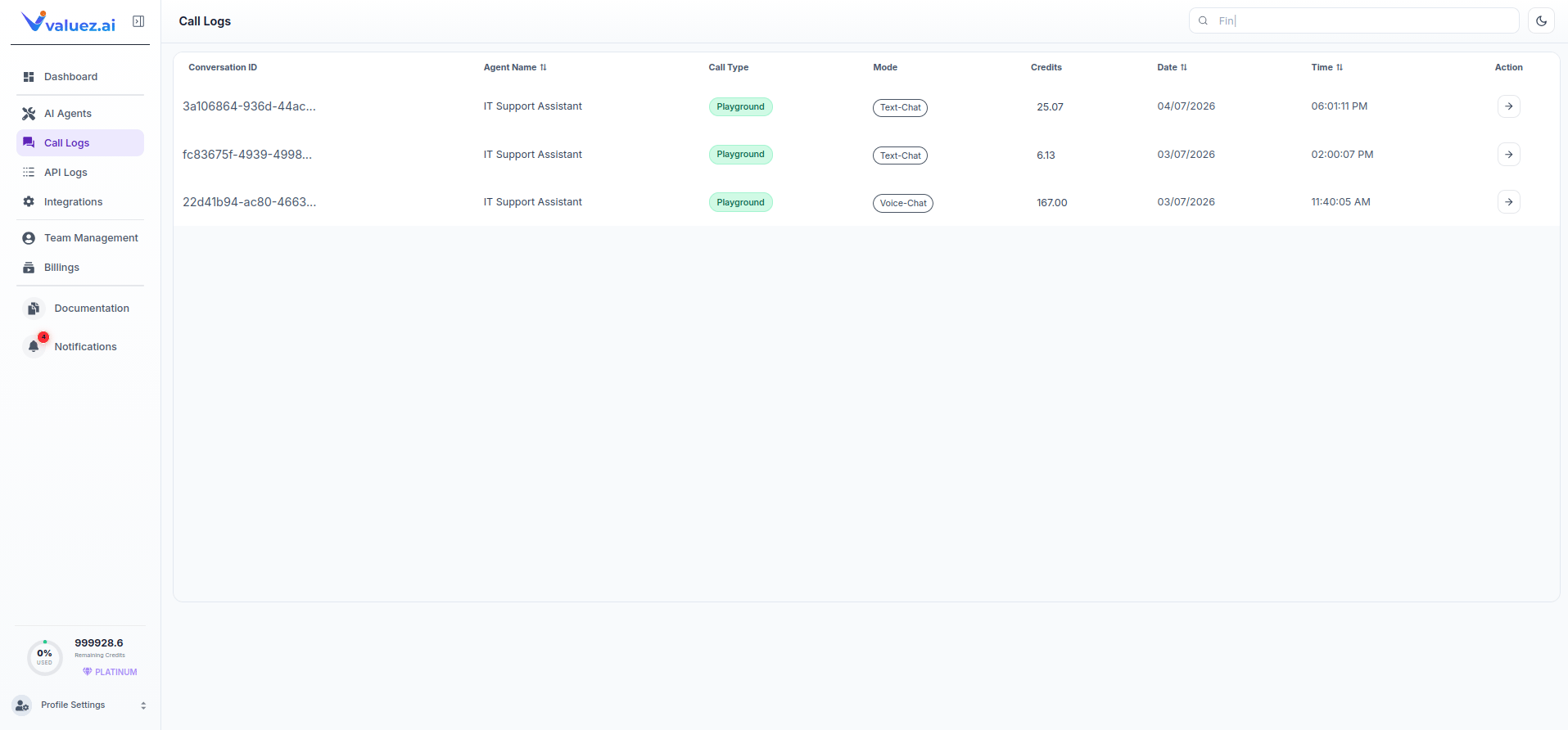 Each row in the Call Logs table represents one conversation. The columns show:
| Column | What It Shows |
| ------------------- | ---------------------------------------------------------------------------------------------- |
| **Conversation ID** | A unique identifier for each conversation - click the arrow to open the full detail view |
| **Agent Name** | The AI agent that handled this conversation |
| **Call Type** | Where the conversation originated - `Playground` means it was a test from the Test Your AI tab |
| **Mode** | Whether it was a `Text-Chat` or `Voice-Chat` interaction |
| **Credits** | How many platform credits were consumed for this conversation |
| **Date** | The date the conversation took place |
| **Time** | The exact time the conversation started |
| **Action** | Click the arrow → to open the full conversation detail |
Use the search bar at the top right to find a specific conversation by ID or agent name.
***
## Conversation Detail View
Click the arrow on any row to open the full conversation detail. The detail view has three panels.
Each row in the Call Logs table represents one conversation. The columns show:
| Column | What It Shows |
| ------------------- | ---------------------------------------------------------------------------------------------- |
| **Conversation ID** | A unique identifier for each conversation - click the arrow to open the full detail view |
| **Agent Name** | The AI agent that handled this conversation |
| **Call Type** | Where the conversation originated - `Playground` means it was a test from the Test Your AI tab |
| **Mode** | Whether it was a `Text-Chat` or `Voice-Chat` interaction |
| **Credits** | How many platform credits were consumed for this conversation |
| **Date** | The date the conversation took place |
| **Time** | The exact time the conversation started |
| **Action** | Click the arrow → to open the full conversation detail |
Use the search bar at the top right to find a specific conversation by ID or agent name.
***
## Conversation Detail View
Click the arrow on any row to open the full conversation detail. The detail view has three panels.
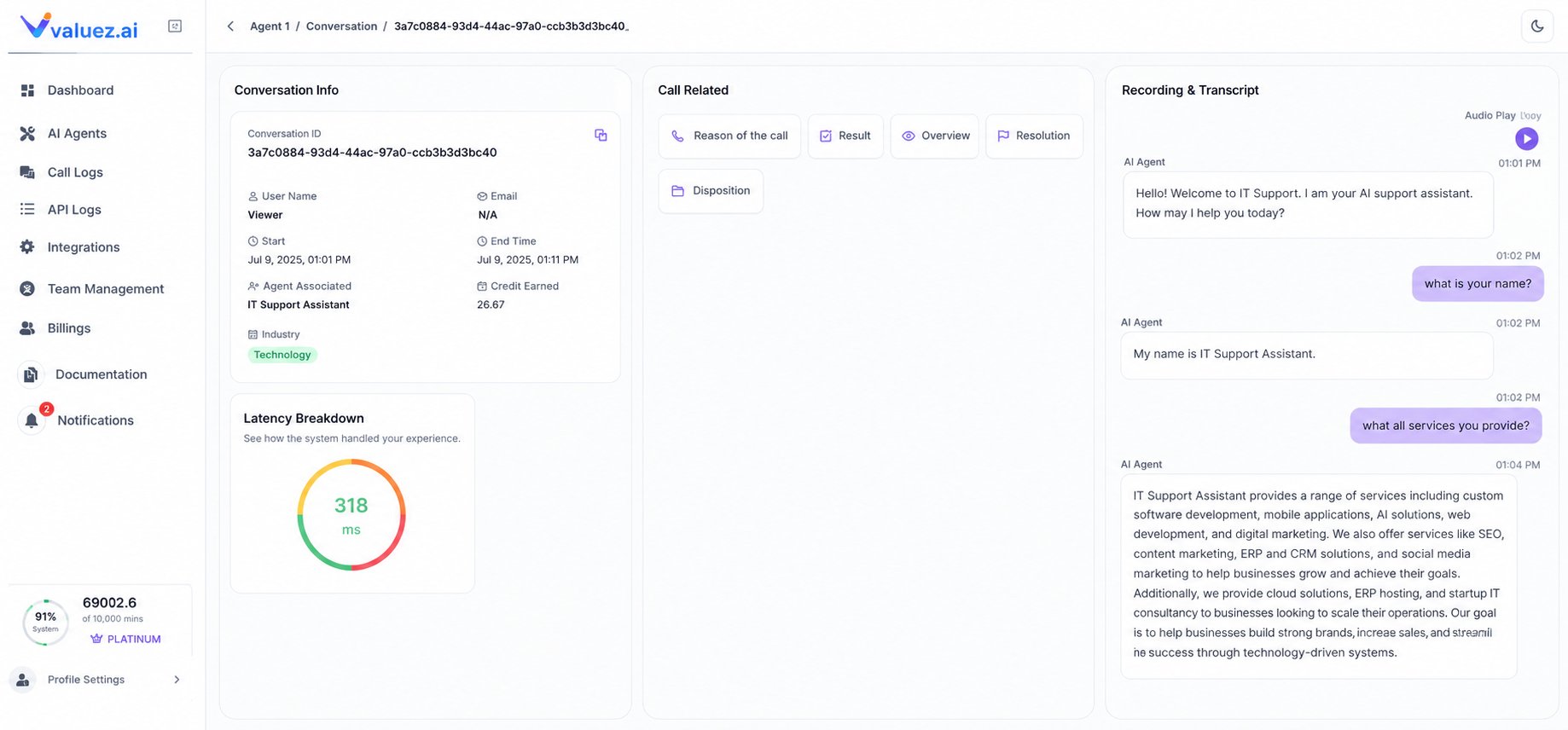 ### Left Panel - Conversation Info
The Conversation Info panel shows all metadata for that specific conversation:
| Field | What It Shows |
| -------------------- | --------------------------------------------------- |
| **Conversation ID** | The full unique ID - click the copy icon to copy it |
| **User Name** | The name the caller provided during onboarding |
| **Email** | The email the caller provided during onboarding |
| **Start** | Date and time the conversation began |
| **End Time** | Date and time the conversation ended |
| **Agent Associated** | Which agent handled this conversation |
| **Credit Consumed** | Exact credits used for this conversation |
| **Industry** | The industry tag of the agent that handled it |
Below the metadata, the **Latency** gauge shows the average response time in milliseconds for this conversation. Lower latency means faster, more natural responses. The gauge uses a colour scale - green indicates healthy latency, yellow indicates moderate, and red indicates high latency that may have affected the caller experience.
### Middle Panel - Call Related
The Call Related panel contains tabs for additional call analysis:
| Tab | What It Shows |
| ---------------------- | ------------------------------------------------------ |
| **Reason of the call** | AI-detected reason why the caller contacted your agent |
| **Result** | The outcome of the conversation |
| **Overview** | A summary of what happened during the call |
| **Resolution** | Whether the caller's issue was resolved |
| **Disposition** | Final classification of the call |
These fields are populated automatically by the platform after each conversation. They become more useful as your call volume grows.
### Right Panel - Recording & Transcript
The Recording and Transcript panel shows the complete conversation in real time order - every user message and every AI agent response, with timestamps.
User messages appear on the right in purple. AI Agent responses appear on the left in white. Each message has a timestamp showing exactly when it was sent.
This transcript is your most important tool for improving your agent - read it to identify where responses were incorrect, too long, off-topic, or where the agent struggled to understand the caller.
***
## How to Use Call Logs to Improve Your Agent
Open your most recent call logs and read through the full transcripts. Look for any response that doesn't match what a real customer would expect.
If the agent gave a wrong answer - it's a knowledge base issue. If the agent behaved incorrectly - for example, being too verbose or not escalating when it should - it's a prompt issue.
For knowledge base issues, go to Train Your AI and update the relevant FAQ, product, service, or document. For prompt issues, go to Basic Details → System Prompt and add or adjust the relevant instruction.
After making changes, use the Test Your AI tab to verify the agent now handles that scenario correctly.
Check the Credits column regularly. Unusually high credit consumption on a single conversation may indicate the agent is giving very long responses -
adjust Response Length in Basic Details → LLM Model.
***
## Understanding Call Types
| Call Type | What It Means |
| -------------- | ------------------------------------------------------------------------------------- |
| **Playground** | A test conversation made from the Test Your AI tab - Text to Text or Speech to Speech |
| **Live** | A real conversation from a connected phone number or website widget integration |
| **API** | A conversation triggered via the Agent API integration |
When you first start using Valuez AI, all your logs will show Playground. Once you connect an integration - a phone number, website widget, or API key - you will start seeing Live and API call types appear.
***
## Related Pages
Run test conversations that will appear in Call Logs so you can review them here.
Go back to your agent configuration to fix issues identified in call transcripts.
Update your knowledge base when transcripts reveal incorrect or missing information.
View aggregated performance data across all your agents and conversations.
### Left Panel - Conversation Info
The Conversation Info panel shows all metadata for that specific conversation:
| Field | What It Shows |
| -------------------- | --------------------------------------------------- |
| **Conversation ID** | The full unique ID - click the copy icon to copy it |
| **User Name** | The name the caller provided during onboarding |
| **Email** | The email the caller provided during onboarding |
| **Start** | Date and time the conversation began |
| **End Time** | Date and time the conversation ended |
| **Agent Associated** | Which agent handled this conversation |
| **Credit Consumed** | Exact credits used for this conversation |
| **Industry** | The industry tag of the agent that handled it |
Below the metadata, the **Latency** gauge shows the average response time in milliseconds for this conversation. Lower latency means faster, more natural responses. The gauge uses a colour scale - green indicates healthy latency, yellow indicates moderate, and red indicates high latency that may have affected the caller experience.
### Middle Panel - Call Related
The Call Related panel contains tabs for additional call analysis:
| Tab | What It Shows |
| ---------------------- | ------------------------------------------------------ |
| **Reason of the call** | AI-detected reason why the caller contacted your agent |
| **Result** | The outcome of the conversation |
| **Overview** | A summary of what happened during the call |
| **Resolution** | Whether the caller's issue was resolved |
| **Disposition** | Final classification of the call |
These fields are populated automatically by the platform after each conversation. They become more useful as your call volume grows.
### Right Panel - Recording & Transcript
The Recording and Transcript panel shows the complete conversation in real time order - every user message and every AI agent response, with timestamps.
User messages appear on the right in purple. AI Agent responses appear on the left in white. Each message has a timestamp showing exactly when it was sent.
This transcript is your most important tool for improving your agent - read it to identify where responses were incorrect, too long, off-topic, or where the agent struggled to understand the caller.
***
## How to Use Call Logs to Improve Your Agent
Open your most recent call logs and read through the full transcripts. Look for any response that doesn't match what a real customer would expect.
If the agent gave a wrong answer - it's a knowledge base issue. If the agent behaved incorrectly - for example, being too verbose or not escalating when it should - it's a prompt issue.
For knowledge base issues, go to Train Your AI and update the relevant FAQ, product, service, or document. For prompt issues, go to Basic Details → System Prompt and add or adjust the relevant instruction.
After making changes, use the Test Your AI tab to verify the agent now handles that scenario correctly.
Check the Credits column regularly. Unusually high credit consumption on a single conversation may indicate the agent is giving very long responses -
adjust Response Length in Basic Details → LLM Model.
***
## Understanding Call Types
| Call Type | What It Means |
| -------------- | ------------------------------------------------------------------------------------- |
| **Playground** | A test conversation made from the Test Your AI tab - Text to Text or Speech to Speech |
| **Live** | A real conversation from a connected phone number or website widget integration |
| **API** | A conversation triggered via the Agent API integration |
When you first start using Valuez AI, all your logs will show Playground. Once you connect an integration - a phone number, website widget, or API key - you will start seeing Live and API call types appear.
***
## Related Pages
Run test conversations that will appear in Call Logs so you can review them here.
Go back to your agent configuration to fix issues identified in call transcripts.
Update your knowledge base when transcripts reveal incorrect or missing information.
View aggregated performance data across all your agents and conversations.